Welcome!

My hope is that there will be some resources here for families with special needs. Instead of reinventing the wheel, I have included resources that point to other resources. The posts here are simply reporting some of the things we have tried to make our daughter's experience more comfortable and productive. Please add any experience you have to help us and others help our children.

Thursday, June 24, 2010

Van For Sale!

We have our handicap van for sale! Hopefully, our price will be fair and helpful to another family and helpful for ours as well. (It's amazing what others are charging for handicap vans of similar age and mileage.)
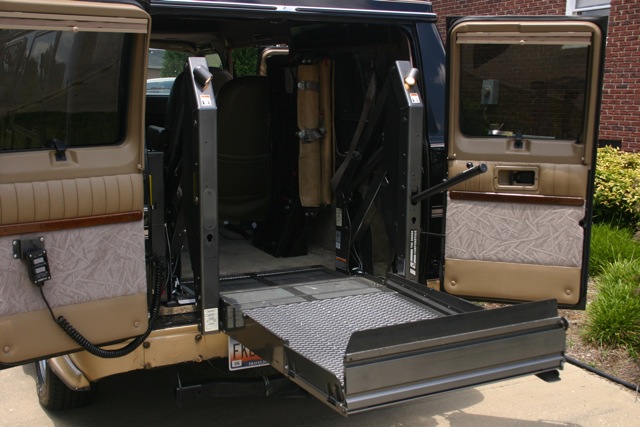
This is a 2000 Dodge Ram Van 1500. -- 113000 miles -- It has a Zephyr conversion package (high top and running boards. The higher top really was helpful when we needed to work on Macayla and stand next to her) -- Braun wheelchair lift and additional seating provided by a jump seat that folds out of the way (see pictures below) -- Power windows, Power locks, CD/Cassette, Cruise, Tilt, Rear Air, Alloy wheels, hitch receiver, power seat, wheelchair anchor system, and more!
For those who are local to our area, the van can be seen at Hayes Auto Sales on Clemson Blvd. in Anderson. Next to or really behind Office Depot. They will be glad to show you the van and let you drive it. They are selling it for us and that means you can do a trade in if necessary.

Their hours are
M-F 9 a.m. - 6:30 p.m.
Sat. 9 a.m. - 4:30 p.m.
Sunday closed.

They are located @ 3415 Clemson Blvd. Anderson, SC
864-226-2472

Asking $10, 500


This control box is connected by an expanding cord. It can be used by the person on the lift or an assistant to operate the lift while standing outside. It moves the lift up and down and folds and unfolds the lift.


There are lights on both sides of the lift and they are very bright and helpful at night.


This switch is out where the person on the wheelchair can operate it once they roll up on the lift. (If they are able. The whole system can be operated by the special friend or their assistant.)


For the lift to clear on the way down, the rear bumper was removed. However, we still have said bumper incase someone wants to convert his back to a standard van.


These help keep the doors open while operating the lift.


There are controls on the inside of the van that control the lift. They are the yellow, orange and red switches on the right side of the lift. See below.


We opted to install the lift in the rear so that our daughter and son could sit side by side. It also helped when she was not doing well and we had to take her somewhere. One of us could drive while the other or a nurse could sit next to her. It also helped with parking. It never fails that a person will park their little compact in the last handicap van spot. With the lift in the rear, we could park in normal spaces and still unload.


These are the Sure-Lok hooks for the wheelchair. There are four of them and the red switch releases it so you can pull more of the blue strap out and hook to the chair. The knob on the side ratchets the strap tighter. Once all four points are hooked on, the chair does not move. If you forget to tighten one, it will self-adjust as you ride down the road and tighten some of the way for you. There is also a seatbelt system for the person in the wheelchair if it is needed.


We had a jump seat installed and it has come in handy. Usually it stays folded up like this and out of the way. Once we pushed our daughter into place, we could lower this down and provide extra seating...

The seat folds down like this, then...


...the back folds up and two people can sit here! It has seat belts also.


Saturday, May 29, 2010

Hospice - Symptoms of Death

This is not what we ever wanted to post. Our daughter, Macayla, finished her fight with Battens and died on May 22, 2010, her 9th birthday. She has been steadily digressing since the fall. But over the last two weeks, we found it difficult to get any information on signs and symptoms for people who had reached the end of life. Fortunately, for us, we had several people around the last few days who had nursing experience with dying patients. They walked us through and prepared us for some of the coming symptoms and bodily responses we might see. We also had hospice nurses who came in from time to time to give guidance and offer support.

My hope is to share our experience so that others may benefit. You may not want to read this and that is completely understandable. But for those who are in the midst of this and are looking for info, we hope and pray they can find something helpful here.

Macayla's autonomic nervous system was being impacted by the disease. That is the part of the nervous system that controls all the automatic functions like breathing, bowels, heart, etc. This indicated that the disease was deteriorating the brain stem. The brain stem is quite resilient compared to the other parts of the brain. But even it cannot withstand Battens. We did not determine this with an MRI but through our genetics doctor who sized up Macayla's symptoms and put it together. This caused Macayla to have sporadic vomiting over the last couple of months as her stomach randomly contracted. Her bladder functioned but had erratic patterns and had to be cathed frequently. This symptom actually showed up over a year ago. At times it was worse than others. We also noticed over the last 6-8 months that her face would go from being red and flushed to pale without any fever or discernible reason. We learned that the autonomic nervous system also controlled how much the blood vessels dilated or constricted. This meant that the blood vessels would randomly open more in her face and make it appear red and flush. At other times they would constrict and there would be less blood flow in her face and she appeared very pale. So, over the last couple of months, we were able to recognize symptoms not previously seen. When our genetics doctor put all of it together, he guessed it was the autonomic system and brain stem being impacted. He was right.

To the tough part. Macayla's experience is, of course, not necessarily what others will endure. But there may be some common symptoms. We are thankful for those who helped us evaluate them and it helped us make Macayla more comfortable. The last week was up and down. Kids who reach the end of life really keep you guessing. Adults can be more steady according to our friends at hospice.
Macayla had a week of frequent vomiting. Then I noticed an unusual breathing pattern on Friday night. She took two quick, deep breaths, followed by a shorter breath and then she would not breathe for about 8-10 seconds. She did not seem in distress. We learned this pattern is called Cheyne-Stokes (pronounced "chain-stokes"). Saturday morning she ran a fever of about 102 and her breathing was a normal pattern, but raspy. We took her in for a chest xray and they said it showed no pneumonia. Sunday night she began vomiting profusely and it was difficult to get her to recover. She had four bouts of vomiting through the night. Between those times, she was asleep, but her breathing was much more intense and started the Cheyne-Stokes pattern again. She seemed to be straining to breathe more than usual and the breaths were raspy. Suctioning did not help.
Her fever returned and got up to 103 and then went back down again without any medication. This indicated her hypothalamus in the brain stem was not functioning properly as it controls body temp. After a touch-and-go all nighter, Macayla recovered and slept most of the next day and night. On Tuesday afternoon, I finally was able to get some responses from her. Her last smile was on Tuesday afternoon. She fell asleep that evening and remained asleep the rest of the time.
The last three days of life we saw the following symptoms. I thought a list might make it easier for you. If you have any questions or want more detail, email or comment.
- Macayla's fever went up and down on its own without medicine over the course of a couple of hours.
- She had Cheyne-Stokes breathing patterns. She may have two or three breaths followed by a apnea spell that would last 10 seconds and as long as a minute (especially toward the end).
- Circulation centralized and blood flow to the limbs slowed. We had a hard time finding a pulse in her feet and legs and even the pulse in her wrist was weak at times.
- Her lungs got "wet" and began to fill with fluids. She sounded raspy on every breath and it got worse over time. She would cough some at first, but most of the time she was unable. In the hospital, they can stick a tube down into the lungs and keep them clearer, but at some point we would face the decision to remove the tube and in Macayla's case she would just start the process again. Intubation (as it is called) would not change what was happening to Macayla or the ultimate outcome for her. For others, it might buy some time if needed. We chose for Macayla to be at home and not attached to machines in the end. For our situation, the machines would not change anything. Each family must decide for themselves what is best.
- Her heart rate stayed elevated. She normally stays between 70-100 bpm, but then she stayed up between 130 - 170 bpm.
- Her kidneys also began slowing down earlier in the week. We had to cath her most of the week and during those last three days, we barely got anything with the catheter. What we did get was very dark and concentrated in smell.
- Her skin also became mottled on the bottom sides of her arms and legs first. This was difficult to notice for me, but the nurses noticed it right away. It looks like splotchy gray and blue discoloration on the skin. It's where the blood seems to not move as much and fluids are settling.
- The intestines and stomach stopped. This we were not prepared for. She started drastically leaking around her feeding tube. Everything just sat and since she was unable to urinate, all of her fluids were finding their way out around the feeding tube. We had to remove the feeding tube and use the suction machine to quickly remove the fluids gushing from her stomach. This helped, but it continued to build up and even had stool in it eventually. Stool will start to back up and can cause a patient to start vomiting stool. We removed the feeding tube multiple times and irrigated her stomach with water and the suction machine. It prevented her from vomiting more. The leaking was so bad we actually wrapped her torso with a diaper to help absorb it.
- Because her stomach did not work, her medicines were not being absorbed. She was not getting her seizure meds and she had multiple grand mal seizures during the last three days. We had started morphine and Ativan to help with nausea and spasms and pain. We had to go to morphine injections and an Ativan cream that absorbed through the skin. We also started a pain patch. There are multiple medications that can be compounded into cream that is absorbed through the skin. Even suppositories may loose their effectiveness if circulation slows down in the lower regions of the body. So, compounded creams can be helpful and applied to the wrists or chest.
- She had a couple of spells where she stopped breathing for several minutes. In fact, the first time she did this it lasted four minutes and her heart stopped beating. We thought that was it and then she started breathing again. As her apnea spells got longer, her heart would slow down, get irregular, and then she would start breathing and the heart rate would jump back up.
- The last few hours of life, her heart rate finally slowed down and stayed close to 100 bpm. She slowed her breathing down to 4 to 6 breaths per minute. Normal is 16-20.
- The nurses told us that often people will stop breathing, but the heart will keep going for several more minutes (as much as 10). But Macayla actually did the opposite. Her heart stopped and she took a few more breaths before it was over.
- One other thing of note. Macayla seemed a bit more responsive on the last day. She opened her eyes with stimulus. It may have been one of the ways she said goodbye. We also tried to reassure her the whole time that she would be o.k. and that we would be o.k. We told her that she could go home anytime she was ready. Dying people need to know this and need reassurance that those left behind are ready. Like with anything our children would do, we wanted to be supportive, but it was the hardest thing to support.

Again, I only wanted to share this because it's hard to find info out there. Our experience was not exactly like others, but from what we gather from hospice and others, many of these symptoms are seen during the end of life.

Tuesday, April 6, 2010

Alternating Air Mattress Helps Prevent Skin Breakdown

Anyone who remains in the same position in the bed runs a risk of skin breakdown and bedsores. Hospitals often have special mattresses that automatically alternate pressure zones to reduce the likelihood of these problems.
Recently, we started noticing more and more issues with skin breakdown and our daughter's OT suggested an alternating air mattress. We discovered there are mattresses that can replace an existing mattress or there are covers that set on top of an existing mattress. Both work on the same principle. They attach to a motorized pump that constantly shifts air around in the different cells in the mattress. This means pressure is moved around and you can remain in the same position longer than on a regular mattress. We rent ours and have found it to be helpful. It is not as hot as memory foam or lamb's wool and when it comes to bedsores, heat and moisture are the enemies. Lamb's wool can help reduce sheering, but these mattresses help with pressure. It is certainly worth looking into if skin breakdown becomes an issue. Our daughter is very comfortable on hers.

Tuesday, January 19, 2010

Video Monitor a Huge Help!

For the last six months, we have been using a video monitor to keep tabs on our precious girl. It was one we got on sale and is made by "Summer" and available at Target and other places. The great features we love is that it is a color camera and monitor, picks up on sound well and has the ability to see in the dark. It also has a built in thermometer and the monitor displays the temp in our daughter's room.
(I enhanced the picture in the monitor here for demonstration purposes.) We found, however, that we needed to have flexibility in where we mounted the camera so that as we changed our daughter's position, we could move the camera to stay in view of her face. That's the best way for us to tell if she was having a seizure. So, I utilized a $14 clamp-mounted desk lamp (sometimes called an architect's lamp) and modified it to hold the camera. The lamp arm clamps to our daughter's bed and gives us an adjustable arm to maneuver the camera position.
I had to remove the light socket and switch, shade and cord from the lamp so as to leave me just the arm and springs. Then using a scrap piece of plywood, I made a platform for the camera to mount on. It has a built in slot for a screw head on the bottom so I simply mounted a screw into the plywood and slid the camera base on. However, there is only one slot (designed for the base to hang on a wall) so I used a rubber band around the other side to keep the camera base from moving. The camera itself swivels and tilts on its base.
With the base secured to the lamp arm, we have a very positional camera. The monitor it transmits to is rechargeable and has a decent range on it. I have only seen trouble with the signal if I get to the complete opposite end of the house (1600 sqft home) or if it gets too close to my wireless router. Other than that, it has been great.
You can even add an extra camera and switch back and forth on the monitor. It has been worth the money for sure.

Wednesday, November 4, 2009

Kangaroo Joey

We tried using a new feeding pump, the Kangaroo Joey, for a month. It certainly has some nice features and I like its user interface and options. It alarms when the feeding is done and the alarm's volume is adjustable. It seems to have more accurate measurements marked on the feed bags than the Zevex Infinity system. It has multiple advantages, but it was not a good fit for us.
We use Elecare formula and it is a powder that has to be mixed. Apparently, powder formulas do not operate well in the Kangaroo system because it has a back-flow prevention valve that is pretty sensitive. The company who makes the Kangaroo stated we would have to blend the formula if we did not want there to be any problems. We noticed however, the post that turns the back-flow prevention valve on the feed set would get out of alignment and make it difficult to insert the set into the machine. We would notice this mainly when the tab on the set would not be centered in its corresponding hole on the pump door. The tab would actually be resting against the outer edge of that hole and would push back once the pump started. Then this would pop the door open and the pump would fail to function. We traded the pump out twice and never could figure out why this kept happening. Our best guess is that something was not quite right with the feed sets.
There are a lot of features we like about this system, but we did not find it to be reliable. We also noticed that the volume it dispensed was inaccurate. It would indicate it had delivered 250 ml of formula but we could tell less had been given. We actually measure our formula with a scale to ensure the volumes are correct. What we mixed and what the pump gave often varied by quite a bit. So, we have gone back to the Zevex pump and are dealing with the issues it presents. But it seems to be more accurate and is not as sensitive to mixed formula.

Tuesday, October 20, 2009

Kangaroo Joey vs. Zevex Infinity

We have switch feeding pumps from the Zevex Infinity to the Kangaroo Joey. Like anything there are pros and cons to either system. But so far, I prefer the screen and interface of the Joey over the Infinity. Without having to change screens, you can view where you are in a feeding. It doesn't seem to be as finicky once it is loaded and running. The Zevex can alarm often if the bag's set is not loaded perfectly or if one sensor is not happy about its readings. The alarming can be frustrating and hard to diagnose. However, actually loading the Joey has proven to be a bit troublesome. There is a back flow prevention valve in the tubing that has to be set in all the way for it to operate properly. Sometimes you have to push it in quite forcibly to make sure it is seated. The good thing is you know immediately if it is not seated correctly because the door on the pump will not stay closed if it is wrong. I also like how the feed bag is similar to an IV bag and more accurately shows the amount of formula inside. The Zevex feed bags, at least the 500 ml bags, were not accurate in their markings. The Joey also has a faster priming function.

The Zevex does have the advantage in portability and positioning. The Joey requires six inches of fall between the bag and the pump, where as the Infinity can be position any where as long as all the air is out of the bag. The Infinity pump is flatter than the Joey and fits well in most places. The Joey is more cube-like. With Macayla being less mobile these days, we do not have to have these benefits of the Infinity, but for active children, the Infinity is great. The Infinity's door has problems with the latch breaking, but I heard the company is trying some other types of plastics to fix this.

The Joey is new to us and we are waiting on a backpack for it and after we have had more time to learn it, I will post more if needed on troubleshooting.

Monday, September 7, 2009

Versed

We recently tried to control Macayla's grand mal seizures with Versed. Versed (ver - said) is often used in anesthesia and we get it in small, one mL vials. It is med meant to be given via injection, but this would take too long to have impact in the midst of seizures. Therefore, we give it to her buccally meaning between the cheek and gum without a needle. We use a vial cannula to draw up the med and then squeeze a few drops at a time between her cheek and gum. After we put a drop in, we massage that area of her mouth to help it absorb. Then we put the next drop in another place. Macayla's swallowing is impaired and even the single milliliter causes her to choke. We even suction her before we put it in. Within about a minute, we get the entire mL in.
We have tried Versed because she has built a tolerance against Diastat. Unfortunately, the Versed does not have much effect either. This past set of seizures started and I did not wait for a second one. I could see she was not finished, so I gave her Versed immediately after the first one. The second seizure was less severe and she didn't have any more after that. I'm not sure if the Versed was the difference or if she simply was not going to have as many seizures that time. The bonus for using versed is that it is easier to administer. Diastat is a rectal gel and obviously requires us to pull down Macayla's pants and diaper. Versed can be administered while she is in her chair, bed or otherwise. It is supposed to absorb directly into the gums which is faster (and less painful) than an IV or IM injection. We just wish it was more effective. Midazolam is the technical name and also marketed under the names Dormicum, Hypnovel, or Midacum.

Wednesday, August 5, 2009

DIY Beach Wheelchair

Going to the beach is a challenge with special needs. There are beach wheelchairs on the market and most of them will not work for a person with little or no tone to hold their torso or head in place. The real problem is the astronomical cost of these things. I'm not sure how their manufactures keep a clear conscience. I hope this entry encourages folks to make their own. Even if you spent $200-$300 in parts, it is cheaper than one you can get and it will be customized to your needs. I spent less than $130 by using what we had.
So, to overcome this, we made our own. Our local Family Connection office has a beach wheelchair we can borrow, but the seat is at a 90 degree angle which is not helpful for Macayla. Plus it has no lateral or head supports and she is too big for us to sit another type of seat on it. But we used the back wheels off of the chair for the chair we made. Below are some pictures and descriptions of what we did. I've tried to reference any websites for products that help with this. I made the frame out of PVC pipe and it held all 220 lbs. of me. I'm happy it held me, but sad I weigh that much! Anywho, It would be better if made out of furniture grade PVC and the better fittings you can get with it. Since I made the front wheels, I have discovered another way they can be done if you want to spend the money for it. This chair can be broken down for travel.

The beach chair fully assembled.

This was a lounge chair that worked for Macayla as far as angles and reclining ability. It has similar angles to her articulating bed at home. We bought this one at Big Lots for $48. The chair simply sits down in the frame I built. I used heavy zip ties to hold the chair in place, though it could be done with bolts or other ways. Of course the lounge chair folds up for travel.

The blue cover we found at Bed, Bath & Beyond for $20 minus the 20% off coupon. It is terry cloth and is meant to drape over a normal lounge chair. Below are some straps my mom sewed on to it so we could cinch the cover on the chair tightly at the head. This helped to keep the headrest in place (shown a few pictures below).

We created a lateral support system with a child's life vest. It had enough straps on it to strap securely to the chair and stay in place. I added a strap to hold it together around her torso like a big belt. This could also be accomplished easier with the lateral supports that can be ordered for bath chairs. We did not have the time to order any before our trip. Plus this saved us some money. The blue pillows were also bought at Bed, Bath & Beyond. They are designed for lounge chairs and have straps with clips to clip onto the chair. We strapped them onto the arms for extra comfort.

This is the other side of the lateral belt. It is a child's life vest that is worn like a sandwich board. The straps that normally wrap around the child's torso were used to strap the vest to the chair.

We used velcro to attach this hand towel to the life jacket so it would be more comfortable.

This is a close up of the headrest. We found some "hot tub" pillows at Bed, Bath and Beyond on clearance. They are vinyl-coated foam pillows with a weighted flange on them meant for someone to lean their head back on while sitting in a hot tub. We cut the flange off and used one on each side of Macayla's head to keep it in place. The blue lounge chair cover has pockets that hang off of each side to stow stuff. We cut two of the pockets off and they happened to be the right size for these pillows. We sewed the pockets in position and inserted the pillows. My mom utilized some ties from the cover and a button she found at Wal-mart to close the pockets and keep the pillows in. This really kept Macayla's head from flopping over to either side.

As one of the ways to make the chair more compact for travel, I used an old bike carrier for a car. I cut it so that I could slide the 1" PVC pipe over it and use self-tapping screws to hold the pipe onto the tubing of the bike carrier. The arms meant to hold the bikes became the arms that went back to my push handle for the chair. When the chair is disassembled, I can fold up the handle section in the same way the bike carrier folded up.

1" aluminum tubing (available at Lowe's or Home Depot) slides perfectly inside 1" PVC pipe. Here I bolted a PVC pipe to the frame and there is aluminum tubing inside it. The aluminum extends up and is exposed above the frame. The PVC from the bike-carrier handle then slides over the exposed aluminum tubing. I then used a pin from said hardware stores to lock the two together. So, bolts hold the pipe and tubing together and to the frame. A removable pin holds the handle's PVC and tubing together just above the frame.
These are the Roleez wheels we borrowed. There is another brand called Wheeleez as well. They slide perfectly onto the 1" aluminum tubing. Thus, my axel is one long piece of tubing that runs through the frame from one side to the other with enough excess on each side for these wheels. Removable pins keep them from coming off.
This is how the umbrella stays in place. I used a piece of PVC pipe that is screwed to the frame. When we used it on the beach, the pole stuck in the sand acted as a brake as well.

These are the front wheels I made for the chair. They are constructed out of PVC and swivel like normal dolly wheels. They also detach from the frame with removable pins to make packing easier. There are easier ways to accomplish this and there are now dolly versions of the Wheeleez wheels now that can be mounted . But they are not cheap. So, I made these.

This is the detached front wheel. The aluminum tubing inserts into the frame and gives the connection more strength. I found that a 1" coupling fits well into a 1 1/4" coupling or fitting and can spin freely. Using this, I was able to mesh 1" and 1 1/4" fittings to make the dollies spin 360 degrees. The tires here are pneumatic wheels made for hand trucks or garden wagons. I had to use a smaller 1/2" pipe for an axel that could fit inside PVC pipe. Thus, I used an elbow fitting that reduced from 1" to 1/2" at the wheel. This whole assembly should be reinforced with 1" aluminum tubing inside above the 45 degree elbow.

Overall, this chair worked well for us. Macayla really relaxed in it and even fell asleep in it every time we used it. It made it very easy to mover her around the beach.

Tuesday, March 24, 2009

Catheter System

This year, Macayla started struggling from time to time to empty her bladder on her own. We have had to use catheters often and had a system recommended to us that has been great. 

Rusch/MMG makes a self-contained catheter system that can be used by anyone. It is portable and has all that you need. It has Beta-dine swabs for sterilization, a small, fold-out chucks pad, gloves, and a bag with a self-contained catheter and lubricant.

There is a cap on the top of the bag that covers the tip of the catheter. There is lubricant inside the cap. Once it is removed, the catheter extends out of the bag and once it is done, it retracts back into the bag and the cap can be put back on. The bag can be torn open and emptied and
 then thrown away. We have found it to be a quick, simple and convenient system.